Door Closer Maintenance and Adjustment Guide
How door closers work, how to adjust closing and latching speed, and when to service or replace a closer on residential and commercial doors.
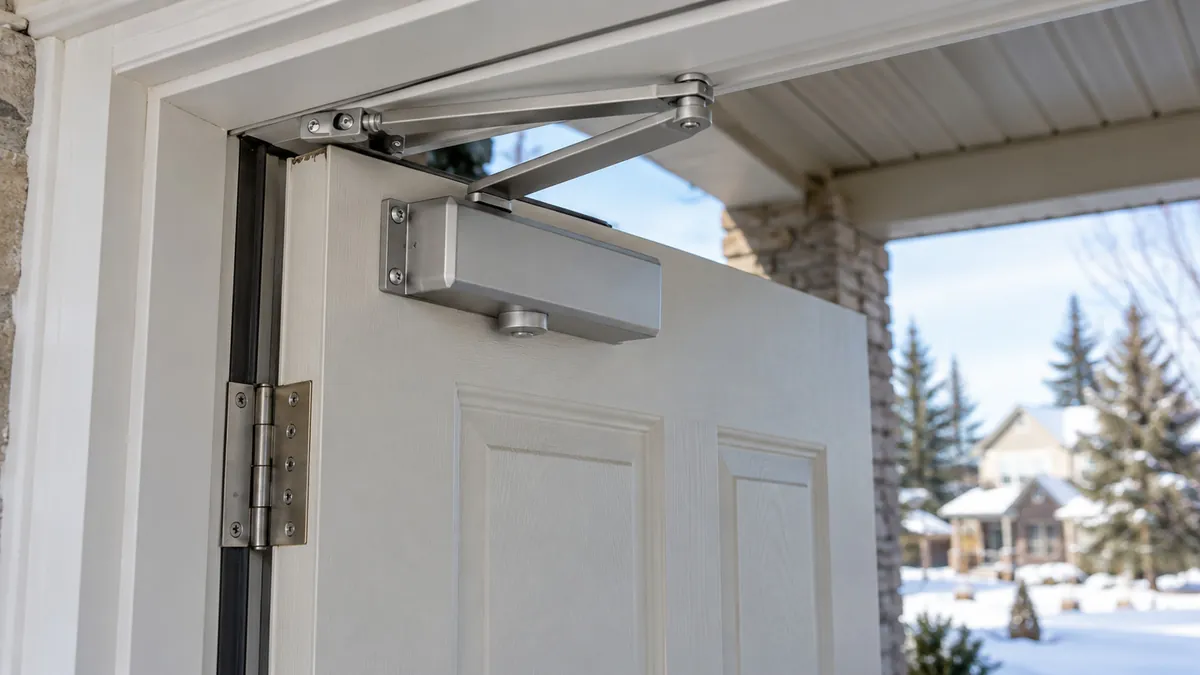
A door closer is a mechanical device that closes a door automatically after it is opened. It is common on commercial entrances, fire-rated doors, apartment building doors, and some residential exterior doors. When it works, you barely notice it. When it fails, the door slams, stays open, or will not latch.
This guide explains how door closers work, how to adjust them safely, and when to service or replace them. It is written for Canadian buildings, where door closers appear on fire-rated assemblies, shared entrances, and doors that must close reliably for security or code compliance.
What a Door Closer Does
A door closer controls the speed and force with which a door closes. It usually mounts at the top of the door or frame, with an arm connecting to the door. Inside, a hydraulic cylinder regulates the movement.
A properly adjusted closer should:
- Close the door fully from any open position.
- Latch the door without slamming.
- Control the speed through the closing cycle.
- Hold the door open briefly if equipped with a hold-open feature, then release it.
On fire-rated doors and shared entrances, a working closer is often a code requirement because it ensures the door is not left open.
Types of Door Closers
| Type | Typical use | Notes |
|---|---|---|
| Surface-mounted closer | Commercial and residential exteriors | Most common, visible arm and body |
| Concealed closer | High-end or architectural doors | Built into the door or frame |
| Floor spring | Glass doors and storefronts | Mounted in the floor |
| Spring hinge | Lighter doors, residential closets | Simple spring, no hydraulic control |
| Overhead concealed | Commercial entrances | Hidden in the frame header |
Surface-mounted closers are the most common and the easiest to inspect and adjust. Concealed units require more disassembly and are usually serviced by a professional.
Adjustment Valves and What They Control
Most hydraulic closers have two or three adjustment valves, often marked with letters or numbers. The exact labels vary by manufacturer, but the functions are consistent:
- Closing speed: controls how fast the door moves from open to about 10 to 15 degrees from closed.
- Latching speed: controls the final few degrees of closure so the latch engages.
- Backcheck: controls resistance when the door is opened past a certain point, preventing it from swinging open too far or too fast.
- Delayed action: on some models, holds the door open briefly before starting to close, useful for accessibility.
Turning a valve screw clockwise usually slows the action. Turning it counterclockwise speeds it up. Adjustments should be small, typically a quarter turn at a time, followed by testing.
Safe Adjustment Steps
If you need to adjust a closer, work methodically:
- Identify the adjustment valves on the closer body. They are usually small screws on the end or face.
- Open the door fully and let it close. Observe whether it slams, closes too slowly, or fails to latch.
- Make a quarter-turn adjustment to one valve at a time.
- Test the door after each adjustment.
- Repeat until the door closes smoothly and latches without force.
Do not remove the closer cover unless you are trained. The internal spring is under pressure and can cause injury if released unexpectedly. Do not adjust a closer on a fire-rated door without understanding the requirements, because incorrect settings can affect code compliance.
Common Closer Problems
| Symptom | Likely cause |
|---|---|
| Door slams shut | Closing or latching speed too fast |
| Door closes too slowly | Closing speed too slow or low temperature |
| Door will not latch | Latching speed too slow or closer worn |
| Door does not close at all | Closer arm disconnected, spring broken, or oil leaked |
| Oil leaking from closer | Internal seal failure; closer needs replacement |
| Door hard to open | Backcheck too strong or closer arm binding |
| Door stays open when it should close | Hold-open engaged or closer arm detached |
A leaking closer cannot be adjusted back to proper operation. It needs replacement.
Temperature Effects
Hydraulic fluid thickens in cold weather and thins in heat. A closer adjusted in summer may slam in winter, or close too slowly in cold. Canadian buildings with exterior doors often need seasonal adjustment:
- Winter: Fluid is thicker; the door may close more slowly. You may need to increase speed slightly.
- Summer: Fluid is thinner; the door may close faster or slam. You may need to slow it down.
Check closer operation at the start of each heating and cooling season.
Fire-Rated and Commercial Doors
For doors between a garage and a home, check the garage-to-house door safety guide before changing a self-closing device.
Closers on fire-rated doors are not ordinary hardware. They are part of a listed assembly, and the closing speed and force must meet code requirements. A door that does not close and latch is a fire and smoke barrier failure.
In commercial buildings, closers also affect accessibility. Doors that require too much force to open, or close too quickly, can be barriers for people with mobility devices. Adjustments should balance security, code compliance, and ease of use.
If you manage a rental, apartment, or commercial building, report closer problems to the property manager or a qualified technician. Do not disable or remove a closer on a rated door.
Maintenance
- Inspect the closer arm and mounting screws quarterly. Tighten if loose.
- Look for oil leaks around the closer body.
- Test closing and latching each season.
- Keep the arm pivot lubricated if the manufacturer recommends it.
- Adjust speed seasonally for temperature changes.
- Replace a closer that leaks oil, will not hold adjustment, or has a broken spring.
Repair or Replace?
Repair is usually appropriate when:
- The closer needs adjustment or a valve screw is loose.
- The arm is bent but can be straightened or replaced.
- Mounting screws are loose and the wood or metal is sound.
Replacement is worth considering when:
- The closer body leaks oil.
- The internal spring is broken.
- The closer will not hold adjustment after service.
- The door is fire-rated and the closer is no longer listed for the assembly.
- The closer is obsolete and parts are unavailable.
A new closer matched to the door weight and use is usually more reliable than repeated service on a failing unit.
What to Photograph Before You Call
- The closer body and arm, mounted on the door or frame.
- The adjustment valves and any visible labels.
- The door fully open and fully closed.
- The closer arm connection points.
- Any oil stains or leaks below the closer.
- The door frame and any fire-rating label.
Take photos in daylight and include a wide shot showing the closer in context.
Frequently Asked Questions
Can I adjust a door closer myself?
Basic speed adjustments are straightforward on surface-mounted closers. Make small turns and test after each one. Avoid opening the internal cylinder.
Why does my door slam in summer?
Hydraulic fluid thins in heat, so the closer closes faster. Adjust the closing speed valve slightly slower.
Why does my door close slowly in winter?
Cold thickens the fluid. Adjust the speed slightly faster, or accept that seasonal adjustment is normal.
Can I remove a closer from a fire door?
No. A closer on a fire-rated door is usually required for code compliance. Removing it can void the rating and create a safety issue.
How long does a door closer last?
A quality closer can last 10 to 20 years, depending on use, environment, and maintenance. Heavy-use commercial doors need attention sooner.
Should I lubricate my closer?
Only if the manufacturer recommends it. Most closers are sealed and do not need user lubrication.
What if the closer arm is bent?
A bent arm changes the geometry and can prevent proper closing. Replace the arm or the closer rather than forcing it.
Does a closer need to match the door weight?
Yes. A closer rated for a light interior door will struggle with a heavy exterior door and may fail prematurely.
Closer Cost Expectations
Treat any figure you see online as a planning range rather than a quote. The actual price depends on the closer type, door weight, and whether the arm or mounting needs work.
As a general planning guide:
- Adjusting an existing closer: usually the lowest-cost option, because it is mainly labour and time.
- Replacing a closer arm: a modest cost, because the part is small and the work is quick.
- Replacing a surface-mounted closer: a moderate cost, because it includes the unit and installation.
- Replacing a concealed or floor-spring closer: a higher cost, because it requires more disassembly.
- Fire-rated closer replacement: a higher cost, because the closer must be listed for the assembly.
- Multiple doors: the per-door cost may drop when several closers are serviced in one visit.
Ask for a written quote that separates the closer unit, arm, labour, and any fire-rating documentation. A single lump sum makes it hard to compare.
Working With Your Contractor on Closers
A good contractor will:
- Inspect the closer and door weight before recommending a replacement.
- Match the closer to the door weight and expected use.
- Adjust closing speed, latching speed, and backcheck for smooth operation.
- Confirm that a closer on a fire-rated door is listed for that assembly.
- Test that the door closes and latches without slamming.
If a contractor suggests replacing a closer without adjusting it first, or installs an unlisted closer on a fire door, get a second opinion.
Door Closer Quick Reference
- Adjust closing speed, latching speed, backcheck, and delayed action in small steps.
- Turn valve screws clockwise to slow, counterclockwise to speed up.
- Test the door after each quarter-turn adjustment.
- Check closer operation each heating and cooling season.
- Replace a closer that leaks oil or will not hold adjustment.
- Do not remove the cover; the internal spring is under pressure.
- Do not disable a closer on a fire-rated door.
- Match the closer to the door weight and expected use.
Can I adjust a door closer myself?
Basic speed adjustments are straightforward on surface-mounted closers. Make small turns and test after each one. Avoid opening the internal cylinder.
How long does a door closer last?
A quality closer can last 10 to 20 years, depending on use, environment, and maintenance. Heavy-use commercial doors need attention sooner.
Next Steps
A door closer that slams, will not latch, or leaks oil should be adjusted or replaced. Windoorly can service commercial and residential closers, adjust speed and latching, and recommend replacements that match your door and any fire-rating requirements.