Foggy Windows: Why Condensation Forms Between Panes
Learn the difference between surface condensation and a failed window seal, what can be repaired, and when a foggy window needs a new sealed unit or full replacement.
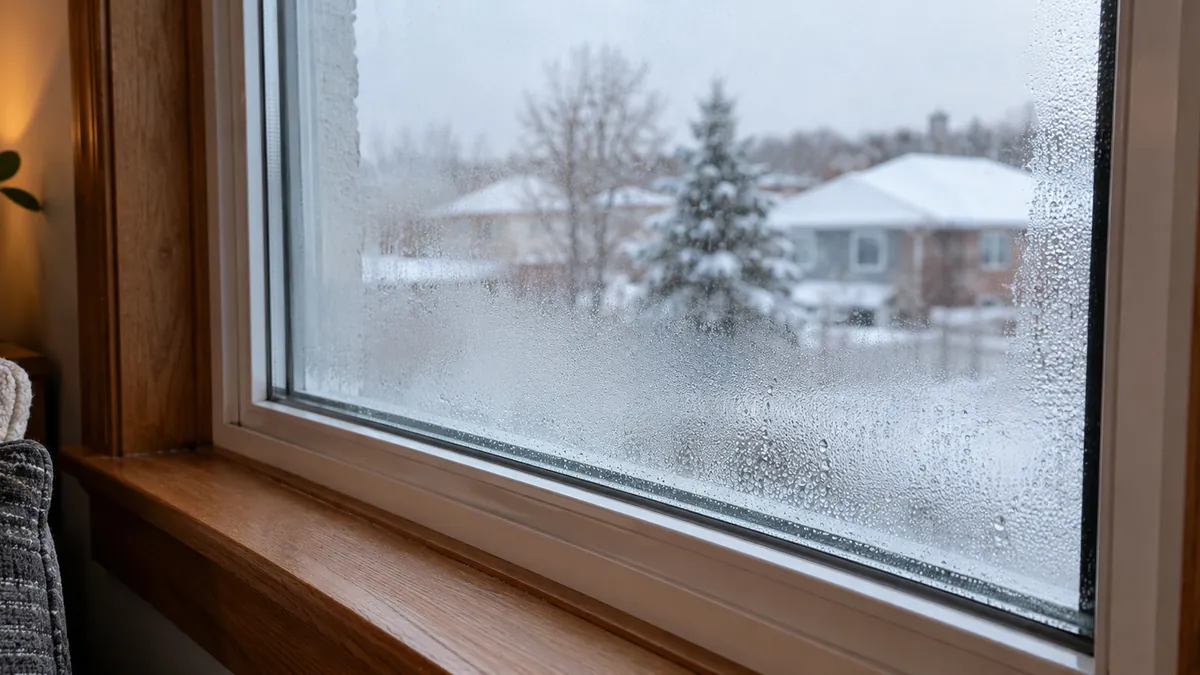
Fog between window panes usually means the sealed glass unit has lost its airtight seal. Moisture has entered the space between the panes and can no longer escape. Surface condensation on the room-side glass is different: it is usually a humidity and temperature issue, not necessarily a failed window.
The distinction matters because the fixes are different. Cleaning the glass will not remove fog that is inside the sealed unit, and replacing the whole window is not always necessary.
This guide walks through how to tell the two problems apart, what causes each one, and what to do next in a Canadian home. It also covers the questions to ask a contractor and the signs that a foggy window is only part of a larger moisture problem.
First: Work Out Where the Moisture Is
Look at the window at different times of day and in different weather.
- On the room-side surface: the glass feels wet or cloudy on the side you can touch. This is surface condensation.
- On the outside surface: the glass is foggy on the exterior, often in the morning. This can be normal and usually clears.
- Between the panes: the fog or water droplets stay trapped inside the glass unit and do not wipe away from either side.
- Along the edges: a white, chalky or cloudy border inside the sealed unit can indicate a failing edge seal.
If you can wipe it off from inside, it is not between the panes. If it remains after cleaning both surfaces, the sealed unit is the likely source.
The Difference Between Surface Condensation and a Failed Seal
These two problems are often confused because they both make a window look cloudy. They are not the same.
| Feature | Surface condensation | Failed seal |
|---|---|---|
| Where it appears | On the room-side or outside surface | Between the panes |
| Can you wipe it off | Yes | No |
| When it appears | Cold weather, high humidity, cooking or showering | Any time, but often more visible in cold weather |
| Typical cause | Indoor moisture and a cold glass surface | A breach in the sealed edge of the unit |
| Usual fix | Ventilation, humidity control, airflow | Replace the sealed unit or the window |
Surface condensation is a household air-quality issue. A failed seal is a window-component issue. Treating one as the other leads to unnecessary spending or to a problem that never gets solved.
What a Sealed Unit Actually Is
A modern sealed unit, sometimes called an insulated glass unit, is more than two pieces of glass. It usually includes:
- Two or more panes of glass.
- A spacer that holds the panes apart.
- A primary and secondary seal around the edge.
- A desiccant, often inside the spacer, that absorbs residual moisture.
- Sometimes a gas fill or a low-emissivity coating to improve performance.
The sealed gap is what gives the unit much of its insulating value. When the edge seal fails, air and moisture can move into that gap. The desiccant absorbs what it can, but once it is saturated, fog or water droplets become visible.
This is why the problem is usually described as a failed seal rather than a glass problem. The glass itself may be perfectly sound. It is the sealed assembly that has stopped doing its job.
Why Surface Condensation Happens
Surface condensation forms when warm, moist indoor air meets a surface that is colder than the dew point. Canadian winters make this common, especially on older windows, single-pane glass and windows in bathrooms, kitchens and bedrooms.
Common causes include:
- High indoor humidity from cooking, showering, laundry or a humidifier.
- Poor air movement behind curtains or blinds.
- Cold glass surfaces, especially on older or single-pane windows.
- A bathroom fan or range hood that is undersized or not used.
- Leaks or damp basements adding moisture to the indoor air.
- Too much houseplant watering or indoor drying of wet clothing.
- Newer, tighter homes that trap moisture without adequate mechanical ventilation.
Try these low-cost checks before assuming the window has failed:
- Run bathroom and kitchen fans during and after use.
- Keep furniture and curtains from blocking airflow across the glass.
- Check the indoor humidity with a hygrometer.
- Look for signs of damp elsewhere, such as musty smells or condensation on cold walls.
- Wipe up surface water so it does not run into the frame.
If the condensation is heavy, persistent or accompanied by frost, the humidity or ventilation may need attention even if the window is working correctly.
Why Fog Between Panes Happens
A sealed glass unit is made of two or more panes separated by a spacer, with a sealed edge and often a desiccant inside the spacer. The seal keeps air and moisture out of the gap. When the seal fails, moisture can enter, and the desiccant eventually becomes saturated.
Once that happens, fog, haze or water droplets can appear between the panes. The seal failure may be caused by:
- Age and normal deterioration of the sealant.
- Repeated expansion and contraction from temperature changes.
- Poor installation or damage to the edge seal.
- Water sitting in the frame or sill.
- A twisted or settling frame that stresses the glass unit.
- Pressure washing or harsh cleaning that damages the edge.
- A manufacturing defect that shows up over time.
A failed seal is not usually a safety problem by itself, but it can reduce visibility and signal that the window is losing some of its insulating performance. It can also be an early warning that water is getting into the frame.
Is Fog Between Panes Always a Failed Seal?
Usually, but not always. A few other things can look similar:
- A dirty or damaged surface that was not cleaned properly.
- A screen or blind casting a pattern that looks like haze.
- Condensation on a storm window rather than the primary unit.
- A failed glazing compound or loose stop that lets moisture reach the edge.
- Moisture trapped during installation in an older or poorly assembled unit.
A contractor can confirm the cause by inspecting the unit and the frame. It is worth doing before you pay for a replacement, because the fix is different for each case.
Can a Foggy Sealed Unit Be Repaired?
Sometimes. The practical options are:
- Replace the sealed unit: a new insulated glass unit is fitted into the existing frame. This is often the best option when the frame and sash are sound.
- Defog or drill-and-clean services: these aim to clean the trapped moisture and reseal the glass. Results vary, and the original insulating performance is not necessarily restored.
- Replace the window: appropriate when the frame is also failing, several components are worn, or the window cannot accept a new unit economically.
A sealed unit replacement is not available for every window. The frame design, age, size and manufacturer support all matter. A window with a sound frame, good hardware and matching trim is often a strong candidate for a new glass unit rather than a full replacement.
What About the Frame and Sill?
Do not stop at the glass. Moisture between panes can be a symptom of a larger problem. Check for:
- Soft or stained wood around the frame and sill.
- Gaps in the exterior sealant or trim.
- Water tracks or staining on the interior wall.
- Loose or cracked glazing stops.
- A frame that is out of square or has separated corners.
If water is entering the wall, replacing only the glass may not solve the problem. The source of the leak needs to be addressed.
Look above the window as well. A gap in flashing, a failing roof detail or an ice dam can send water down into the wall, where it shows up around the window. Replacing the unit without fixing that source may only buy time.
Repair or Replace: How to Decide
Use these questions as a guide:
- Is the frame solid? If yes, a sealed unit replacement may be possible.
- Is the fog limited to one window? A single failed unit is often a repair candidate.
- Are several windows foggy? Widespread failure may point to age or a systemic installation issue.
- Is the window draughty or difficult to operate? Additional failures may make replacement more sensible.
- Is the wall or frame damaged? Address the water source and assess whether the window can be saved.
For a broader comparison, see our guide to window repair vs replacement.
If the fog is accompanied by drafts, read about drafty windows.
A practical rule is to match the repair to the failure. Fog alone, in a sound frame, points to the glass unit. Fog plus a soft sill, a sash that will not close or several failed components points to the whole window.
Planning the Cost
A sealed unit replacement is usually less expensive than a full window replacement, but the price depends on the size, glass type, frame condition and access. A full replacement costs more because it includes a new frame, sash, hardware and installation.
These are planning ranges, not quotes. The actual number will depend on your window, your region and the contractor.
- New sealed unit only: a moderate planning range. Expect the cost to rise with size, special glass, tempered or laminated requirements, and difficult access.
- Defogging service: often presented as a lower-cost option, but compare what is included and what warranty applies.
- Full window replacement: the highest planning range, because it includes removal, a new frame and sash, installation and finishing.
- Multiple units: the per-window cost may change with scale, but each window still needs to be measured and assessed.
Ask for a quote that separates:
- Glass unit and glazing.
- Labour and disposal.
- Any frame or trim repairs.
- Warranty on the unit and the installation.
Do not compare a sealed-unit price with a full-window price without checking what each includes.
Questions to Ask a Contractor
A good conversation before the visit saves time and helps you compare quotes fairly.
- Can you confirm the fog is inside the sealed unit?
- Is a replacement unit available for this window?
- Will the new unit match the existing glass and appearance?
- What glass options are available for my climate and room?
- Is the frame sound enough to accept a new unit?
- What warranty applies to the unit and the labour?
- How long will the window be open during the work?
- What happens if the frame is damaged when the old unit is removed?
- Is disposal of the old unit included?
If the answer to the frame question is uncertain, ask for it to be checked before the unit is ordered. It is better to learn about a soft sill before the glass arrives.
What to Photograph Before You Call
Photos help a contractor understand the problem and prepare the right parts.
- The full window from inside.
- A close-up of the fog or droplets between the panes.
- The frame corners and sill.
- The interior trim and wall below the window.
- The exterior sealant and flashing, taken safely from inside or at ground level.
- Any water staining or soft spots.
- A tape measure across the glass and the opening, if it can be done safely.
Do not lean out of a window or climb on furniture to take a photo. If the exterior needs a closer look, leave that to the contractor.
Preventing the Next Problem
You cannot stop a seal from ageing, but you can reduce the conditions that shorten its life.
- Keep the frame and sill dry. Clear weep holes and fix exterior sealant gaps.
- Avoid pressure washing window edges.
- Do not let water sit against the bottom of the frame.
- Keep interior humidity in a reasonable range for the season.
- Run bathroom and kitchen fans.
- Maintain exterior flashing and roof details above the window.
- Check for condensation after weather changes and address it early.
For surface condensation, the fix is usually airflow and humidity control. For fog between panes, the fix is a new sealed unit or a new window. Keeping the two separate will save you from buying the wrong solution.
Safety and Glass Considerations
A foggy unit is rarely dangerous, but glass still deserves respect.
- Do not drill into a sealed unit to let the moisture out. It will not solve the problem and may damage the glass.
- Do not apply heavy films or coverings that trap heat against the glass without checking suitability.
- If the glass is cracked, loose or visibly damaged, keep people away and arrange an inspection.
- Ask about safety glazing in doors, sidelights, low windows and bathrooms.
- Keep children from playing near a window with loose stops or damaged seals.
If a window is part of an emergency escape route, make sure any repair keeps the opening clear and operable.
Frequently Asked Questions
Can I clean fog between panes?
No. The moisture is sealed inside the unit, so cleaning the accessible surfaces will not remove it.
Does fog between panes mean the window is leaking air?
Not necessarily. A failed seal affects the glass unit. Air leaks around the frame are a separate issue and should be checked separately.
Will a new sealed unit fix condensation on the room side?
It may reduce it by improving the glass temperature, but indoor humidity and ventilation still matter. Surface condensation is a household air issue.
Is a foggy window an emergency?
Usually not. It is mainly a visibility and performance issue. Treat it as urgent if the glass is cracked, the frame is loose or water is entering the wall.
Can I replace just one pane?
Some windows can accept a new sealed unit. Others are built as a single assembly. The window design determines what is possible.
Do I need to replace all the windows if one is foggy?
No. One failed unit is common. Widespread fogging across many windows is a reason to assess the group, not an automatic requirement to replace everything at once.
Will fog return after a repair?
Any seal can fail over time. A properly fitted unit with a clear warranty gives you the best chance of a lasting repair.
Next Steps
Arrange an on-site assessment if:
- You can see fog or water between the panes.
- The fog returns after cleaning.
- The frame or sill feels soft or shows water staining.
- More than one window in the same area has failed.
- You are planning to sell or renovate and need a clear scope.
Windoorly can assess whether the existing frame can accept a new sealed unit or whether replacement is the more reliable fix.
Send us a photo of the fog and a description of the window, and we will explain the likely next step. Request an assessment.